Choose the smallest promise a visitor can evaluate
Start with a bounded result, not an imagined application. A page can promise that a freelance operator sees unresolved client approvals in one place, but must not suggest a complete workflow exists. State role, situation, and alternative. Leave out adjacent personas and features that blur the test.
A usable MVP lets someone complete and return to a task. A landing page displays a proposition and captures a limited response. Use it to test promise and audience before the workflow.
Copyable landing page MVP test plan
Define the promise, channel, and decision point before publishing.
LANDING PAGE MVP TEST PLAN

Decision
[build, narrow, revise, pause, or investigate]

Audience and problem
[role] in [context] faces [trigger] and uses [workaround].

Smallest displayable promise
[one outcome without a product demo]

What the page is not
This is not [unavailable capability]. It is a concept test.

Truthful next step
After [CTA], [actual outcome].

Channel and denominator
[channel]
Count [plausible target visitor] until [number] or [review date].

Signal and counterevidence
Signal: [defined action from qualified visitor]
Counterevidence: [alternative, mismatch, objection, or non-use]

Threshold and stop rule
If [signal and context], [next test]. This threshold is local, not an industry benchmark.
Pause or revise if [condition], including insufficient exposure.

Version and review
Publish [version]. Review on [date]. Keep the promise fixed until [decision point].

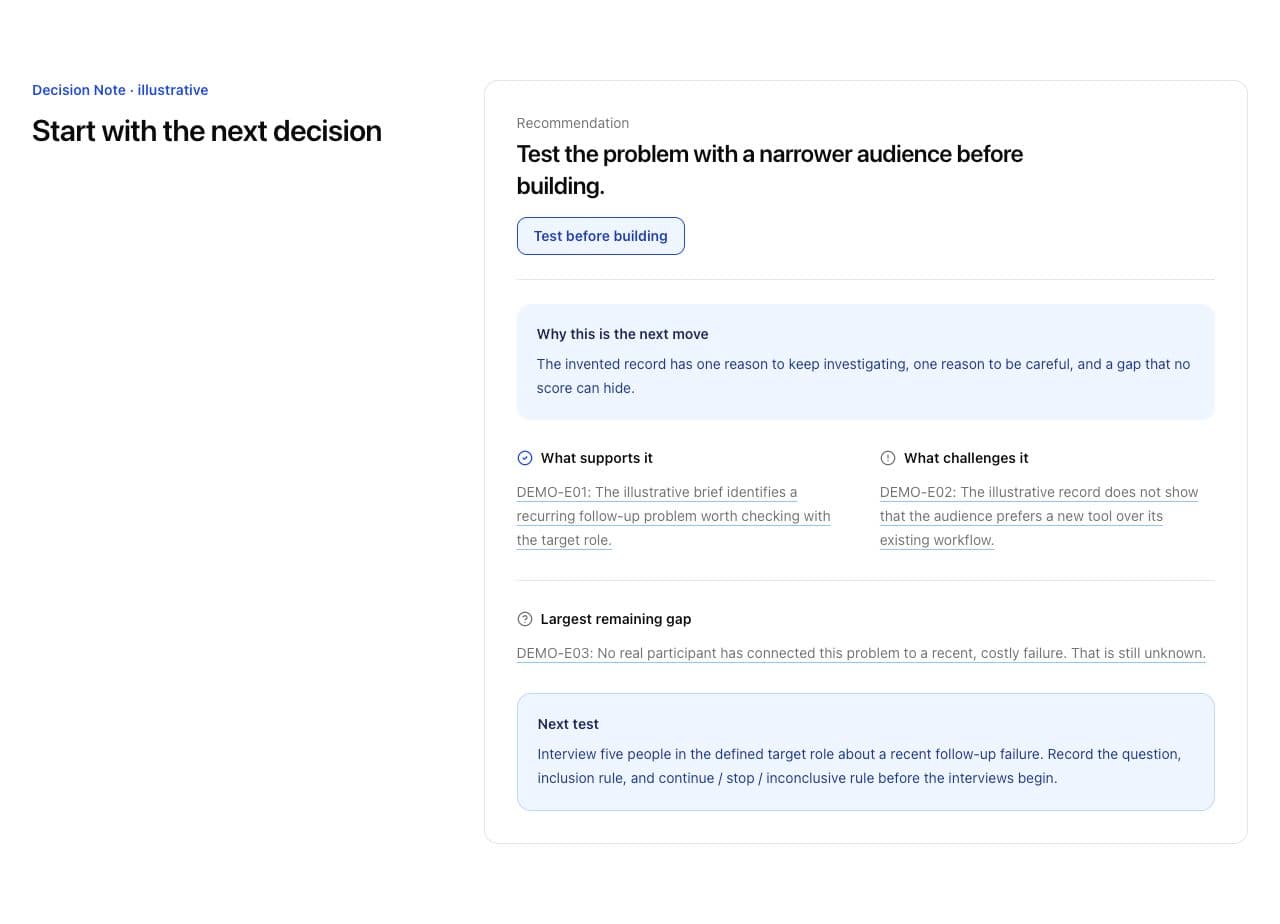
Decision note
Supports: [statement]
Challenges: [statement]
Unknown: [statement]
Next action: [statement]
Plan acquisition, versions, and a decision window
A page without a channel is not a market test. Name how the audience can encounter it, what counts as qualified exposure, and what you will record. Keep that denominator distinct from generic visits; newsletter, partner, and search traffic have different selection effects.
Publish a named version with one CTA and status note. Freeze the promise for a bounded review cycle. Changes to wording, audience, or form friction create a new version. Set a review date or exposure limit, a threshold for a small follow-up, and a stop rule for inconclusive acquisition.
Fictional illustrative example
Fictional example: a page before an operator dashboard exists
A fictional founder tests a promise for solo bookkeeping operators who chase document approvals. Instead of an entire client portal, the page offers one outcome: see approvals blocking monthly close. It says the dashboard is not usable, and asks about a recent blocked close. In a permissioned group, 60 plausible target visitors see version A over two weeks. Six respond: three name manual chasing, two have an adequate portal, and one is not in the role.
This does not prove a market or revenue opportunity. It supports a narrower follow-up about manual chasing and challenges the assumption that every operator lacks a portal. The next test is interviews or a limited manual workflow, not a claim that six leads validate an MVP.
Keep lead capture separate from product evidence
A form submission shows interest, not payment or continued use. Read the stated context, constraints, and alternative. An explicit mismatch or sufficient current solution is evidence against the framing. A positive result may justify a conversation, manual service test, or narrower page.
A landing page is not automatically a fake-door test because the product is unavailable. Fake doors commonly test an entry to a proposed feature in context. This guide focuses on a small displayable promise, transparent publication, and a controlled version cycle. Both require honest disclosure and relevant acquisition.
Do not let a polished page substitute for a test
Avoid publishing before choosing the audience and channel, changing the headline after every visit, or treating total traffic as qualified exposure. Do not label leads as customers, hide the status behind coming soon, or run a paid campaign without a stop condition. A polished page can increase attention while reducing clarity.
Is a landing page an MVP?
It is an MVP of the message and acquisition test, not necessarily a usable minimum viable product. It cannot show whether people can finish the job or return to a working product.
Does a form submission validate willingness to pay?
No. It may justify a next question, but payment intent needs a separate, honest test with its own terms and observations.
When should I change the landing page?
After the decision window, or when a required disclosure is wrong. Treat a changed promise, audience, or CTA as a new version rather than combining it with the earlier page.
Publish a controlled concept-page version
Create a project, prepare its public brief, and choose from two page templates and three styles. Edit the page, set a private plan, and publish on a system subdomain. Built-in forms accept responses even when analytics is declined; visit, CTA, and section measurement require analytics consent. All submissions and consented sessions have different coverage and cannot be combined into an overall conversion rate. Immutable versions and decision snapshots preserve the test context. You acquire visitors and run the experiment; operations handles research separately. Template editing is available without AI, which is not currently configured. There is no automatic plan import, ad placement, or randomized A/B allocation.